
Written by Anthony Awadalla, President of Feel Right Inc.
How human-centered storytelling, cinematic commercials, and brand films help AI companies overcome skepticism, showcase their technology, build credibility, and connect with real people.
There’s something I keep hearing in meetings with AI companies.
We start by discussing their technology. What they’ve built, what makes it different, and why they believe it could change the way people do things.
But eventually, a familiar concern comes up.
Many of these companies recognize that there’s still a great deal of skepticism surrounding artificial intelligence. Not everyone trusts it, not everyone welcomes it, and for some audiences, simply hearing that a product is “AI-powered” can create hesitation before they even understand what it does.
As a result, there’s a recurring desire to make their brands feel more human, approachable, warm, and inviting. They want to establish credibility, build meaningful connections with their audiences, and make their technology feel like something that belongs in people’s lives rather than something to be wary of.
It’s a fascinating challenge because the technology itself isn’t necessarily the problem. It’s how people perceive it, and more importantly, how companies choose to communicate its value.
And that’s where I believe messaging, human-centered storytelling, and commercial video production can make a meaningful difference.
But I don’t think the answer is to make AI seem more human.
I think the answer is to make the problem it solves more human.
Show people something they recognize. A frustration they’ve experienced. A challenge they face every day. Something they wish could be easier.
Then demonstrate how the technology can actually help.
Instead of asking people to embrace artificial intelligence, you’re inviting them to consider a solution to something they already care about.
AI Companies Have a Messaging Problem, Not Just a Technology Challenge
When companies develop something innovative, they’re naturally excited about the technology behind it.
The proprietary algorithms. The advanced models. The automation. The engineering breakthroughs.
And understandably, they want to show the world how impressive it all is.
But consumers don’t necessarily connect with technological innovation the same way the people building it do.
What feels revolutionary to an engineer might feel confusing, intimidating, or simply irrelevant to someone experiencing it for the first time.
For some audiences, emphasizing artificial intelligence too heavily can actually create a barrier.
There are ongoing debates about AI’s impact on employment, creativity, privacy, human relationships, and society as a whole. These are real concerns, and they aren’t going away.
But AI is here. It’s already becoming part of countless products, services, and everyday experiences.
The question for companies building these products is how to communicate their value to people who may not necessarily be looking for more AI in their lives.
And that’s why the message matters so much.
People don’t necessarily want more AI. They want fewer problems.
They want their lives to be easier, their work to be more efficient, their experiences to be better, and their frustrations to disappear.
If your technology can genuinely help accomplish those things, that’s where the story should begin.
Stop Making AI the Hero. Make the Human Problem the Story.
One of the most common approaches to technology commercials is to make everything look futuristic.
Floating user interfaces. Complex animations. Digital environments. Glowing graphics. Technical demonstrations.
There’s absolutely a place for these elements in professional video production, especially when visualizing technology that would otherwise be difficult to understand.
But impressive visuals alone don’t create an emotional connection.
At Feel Right Inc., when we’re developing a commercial or brand film for a technology company, one of the most important questions we ask is:
What real human problem does this product solve?
Not just what the technology does.
What does it actually change for someone?
Maybe it’s a parent trying to find a better way to support their child’s learning without introducing more screen time.
Maybe it’s someone shopping online who struggles to know whether a product will look or fit the way they expect.
Maybe it’s a business owner overwhelmed by tasks that take time away from what they love doing.
These are situations people understand immediately.
Once we’ve established that human problem, we can introduce the technology as an aid.
Something that makes life easier, removes friction, creates opportunities, or gives people more control over their experience.
Now the audience isn’t being asked to embrace artificial intelligence for the sake of artificial intelligence.
They’re being introduced to a solution to something they already care about.
And that changes the conversation.
Show the Product in Action Without Losing the Human Story
One thing almost every technology company wants from its commercial is the opportunity to showcase the product.
And understandably so.
These companies have invested enormous resources into developing technology they believe is genuinely different. They want audiences to see the features, understand the capabilities, and recognize what makes their product worth adopting.
We absolutely want to accomplish that.
Human-centered storytelling and product demonstration aren’t competing creative directions. The most compelling commercials find a way to do both.
The key is integrating the product naturally into the narrative.
Rather than stopping a story to introduce an interface or explain a series of features, we can build moments where the product becomes an essential part of what’s happening on screen.
A character encounters a problem. They interact with the technology. We see the product responding, the functionality in action, and ultimately how it changes their experience.
The demonstration becomes part of the story instead of feeling like an interruption.
There are also exciting production techniques that allow us to showcase sophisticated AI technology without sacrificing the visual language of a cinematic commercial.
Natural Product Integration
We can incorporate a product into the actions, environments, and behaviors of the characters.
Rather than having someone speak directly to the camera about what a device or application does, we show it being used within a recognizable situation.
The product has a purpose within the scene, and its capabilities become visible through the character’s experience.
Screen Demonstrations and Visual Effects
For software, apps, and AI-powered platforms, screen replacement and visual effects can be particularly valuable.
Through VFX, motion tracking, screen compositing, and interface animation, we can incorporate product demonstrations directly into live-action footage.
A character might interact with a phone, computer, or smart device while the audience clearly sees the interface and its functionality.
We can move between the person’s reactions and the product experience, or use carefully designed graphic overlays to reveal processes that would otherwise be difficult to see.
These techniques also allow us to maintain precise control over screen visibility, timing, and visual clarity in post-production while accurately representing the product’s real capabilities.
Cinematic Visualization of Complex Features
Sometimes the most compelling technology isn’t easily visible on a screen.
Animation, CGI, and visual effects can help communicate underlying processes, transformations, and product capabilities that are otherwise abstract.
The objective isn’t simply to make the technology look futuristic.
It’s to make an impressive capability understandable and desirable.
Because showing a viewer how something works is valuable.
But showing how it works in the context of why they need it is far more compelling.
How Commercial Video Production Can Humanize an AI Brand
A well-produced commercial or brand film can communicate an entire human experience in a matter of seconds.
Through casting, performances, cinematography, music, production design, and storytelling, we can establish a recognizable situation and make an audience feel something before we’ve even introduced the product.
That emotional context matters.
We can show frustration without explaining it.
We can demonstrate a problem through someone’s behavior.
We can show the relief, excitement, confidence, or freedom that comes from finding a better way to do something.
And we can make those experiences cinematic, aspirational, funny, dramatic, or deeply personal, depending on the brand.
Authentic Casting and Relatable Characters
Real faces and believable human experiences help audiences see themselves in a story.
The people we cast should reflect the audience the product is intended for, with recognizable behaviors, motivations, and emotions.
Cinematography and Visual Identity
Lighting, composition, color, camera movement, and production design influence how a brand feels.
An AI company might want to communicate sophistication, reliability, creativity, confidence, or approachability.
Our role as filmmakers is to translate those qualities into a distinct visual language.
Lifestyle-Driven Storytelling
Showing technology within recognizable environments provides context.
Rather than presenting a product in isolation, we demonstrate how it fits into someone’s home, career, family life, or everyday routine.
The environment becomes part of the storytelling, helping viewers understand where the product belongs in their world.
Examples From Our Work: SpreeAI and Ahmi
We’ve applied this human-centered storytelling philosophy to different AI-powered products, each with its own audience, challenges, and creative objectives.
SpreeAI: Bringing AI Fashion Technology Into a Human Story
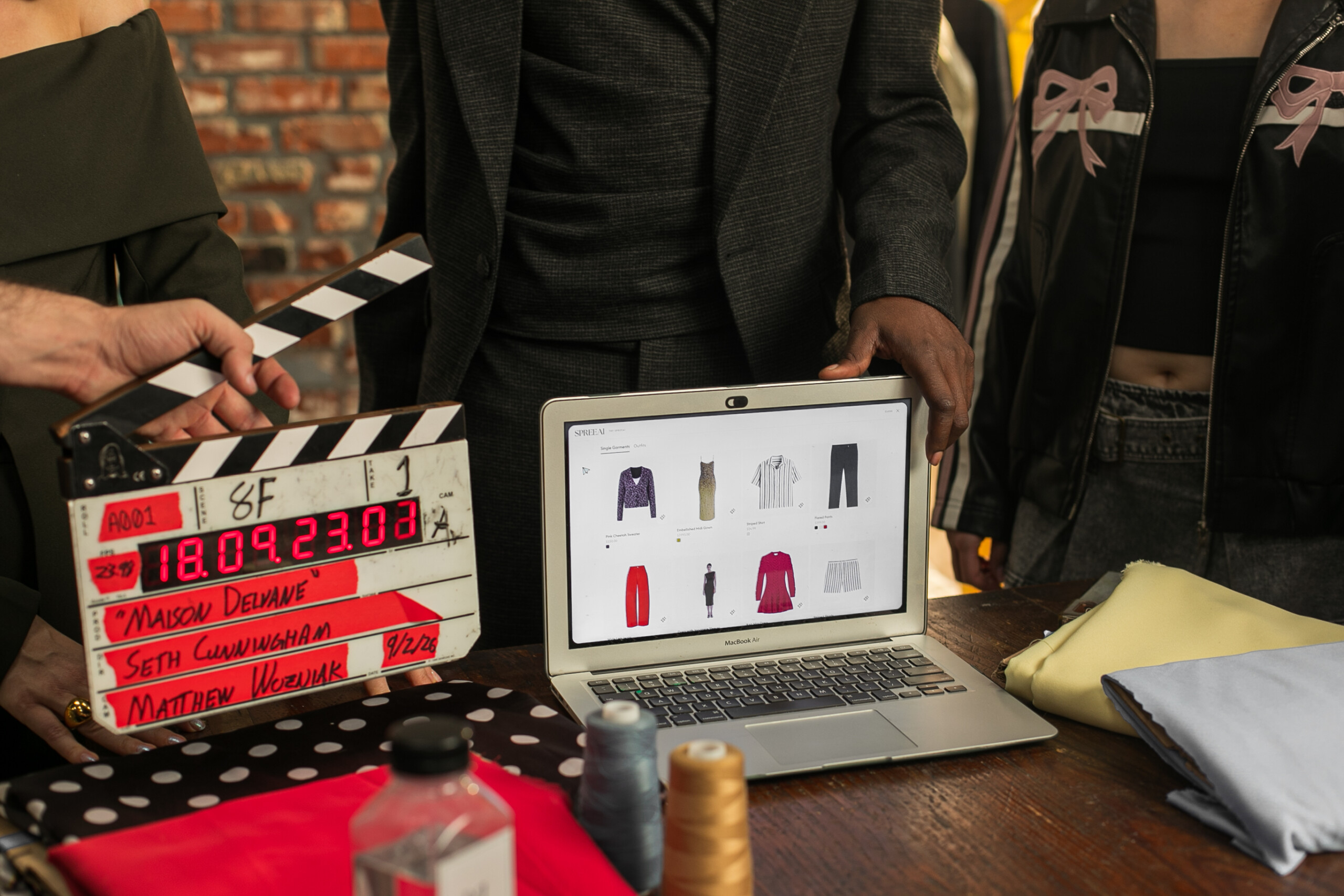
For SpreeAI, a company developing proprietary AI-powered fashion technology and virtual try-on experiences, we produced Maison Delvane, a seven-episode scripted branded micro-series set within the luxury fashion world.
SpreeAI’s technology addresses a significant challenge in online fashion shopping.
Customers often struggle to visualize how clothing will look or fit before making a purchase. That uncertainty can contribute to abandoned shopping carts, missed sales opportunities, and product returns when expectations don’t match reality.
These aren’t just technical problems. They’re real human frustrations with meaningful implications for both shoppers and fashion brands.
SpreeAI didn’t necessarily come to us concerned about humanizing its brand. The opportunity was to create content that connected with the luxury fashion audience it wanted to reach.
Instead of producing a conventional AI explainer video, we developed a branded entertainment experience rooted in the fashion industry itself.
Through characters, ambition, rivalry, drama, and the business of luxury fashion, the series speaks the language of its intended audience.
The technology belongs in a world viewers can recognize and become invested in, rather than existing exclusively as a list of technical features.
It’s an example of how branded storytelling can create meaningful context around a product and the industry it serves.
Ahmi: Making AI About Parenting, Not Artificial Intelligence
With Ahmi, an AI-powered early childhood learning and family hub, the creative opportunity was entirely different.
Rather than leading with the artificial intelligence behind the product, our film focused on challenges parents already understand.
The desire to support children’s development without relying heavily on conventional tablets and screen time.
The difficulty of managing everyday parenting responsibilities while trying to create meaningful learning experiences.
And the frustration of juggling multiple disconnected devices and tools when one centralized hub could simplify family life.
Those were the human benefits worth communicating.
Our approach focused on the product’s role in family life, giving its features and capabilities a relatable context rather than making AI the central selling point.
Because parents aren’t necessarily looking for another AI-powered device.
They’re looking for ways to help their children learn, create healthier habits, and make everyday life a little easier.
Both projects had different audiences and creative executions, but the underlying approach was the same: lead with what people care about, then demonstrate why the technology matters.
Brand Films vs. Product Videos: What Should AI Companies Produce?
There’s an important distinction between explaining a product and establishing a brand.
An explainer video can tell someone how the technology works.
A product demonstration can show its capabilities.
But a brand film or commercial has an opportunity to communicate something bigger.
What does this company understand about its audience?
What does it stand for?
Why does its product deserve a place in someone’s life?
For AI companies, these questions are particularly important because they’re often introducing products and experiences that didn’t exist before.
Different video formats can serve different purposes:
AI brand films establish a company’s identity, personality, vision, and purpose through cinematic storytelling.
AI commercials connect product benefits with compelling creative concepts designed to generate awareness, interest, and action.
Product demonstration videos show how technology works and make complicated capabilities easier to understand.
Branded entertainment and narrative series build stories around the culture, interests, and experiences of a target audience.
Founder and company films introduce the people, motivations, and expertise behind the technology, giving audiences a better understanding of the organization they’re considering trusting.
These formats can also complement one another.
A single commercial production can generate a hero film, shorter advertising edits, vertical social content, product-focused cutdowns, and additional assets for websites, presentations, and launches.
The important thing is choosing the creative approach based on what the audience needs to understand, feel, or believe.
Our Approach to AI Commercial and Brand Film Production
At Feel Right Inc., our production process starts long before the cameras, lighting, locations, or visual effects.
We begin by understanding the company, the product, and most importantly, the audience.
Who are we trying to reach?
What do they care about?
What problem does the product solve?
What makes the technology different?
And what might prevent someone from wanting to adopt it?
From there, our directors and creative teams develop concepts that connect the product’s capabilities with authentic human experiences.
Sometimes that’s a cinematic narrative with actors and carefully designed environments.
Other times, it’s a lifestyle commercial, a visually ambitious product demonstration, or a branded entertainment concept built around a specific audience.
We also plan how the product will appear in the film from the beginning, identifying the moments when viewers need to see the interface, understand a feature, or witness an outcome.
That approach allows storytelling, product cinematography, VFX, and post-production to work together as parts of the same creative vision.
The format is determined by the message and creative strategy, not simply by the fact that the company operates in artificial intelligence.
Our production capabilities include creative development, directing, casting, cinematography, production design, live-action filming, editing, animation, and visual effects.
But those are the tools we use to communicate the idea.
They’re not the idea itself.
Ultimately, we’re trying to build a cohesive brand identity that makes unfamiliar technology feel more relevant, credible, approachable, and genuinely useful.
Why Human-Centered Filmmaking Still Matters in the Age of AI-Generated Content
There’s an interesting irony in the conversations we’re having with AI companies.
As AI-generated imagery, video, and creative tools become more accessible, many companies developing AI-powered products are actively looking for ways to make their brands feel more authentic and human.
And I think that says something important about the role of creativity.
AI production tools can be incredibly useful. They can expand creative possibilities, support visualization, and help bring ambitious ideas to life.
But compelling brand storytelling requires more than visually impressive content.
It requires an understanding of human behavior.
A recognizable point of view.
Creative decisions that communicate something meaningful.
And a story that gives the audience a reason to care.
Whether a campaign is produced through traditional live-action filmmaking, animation, AI-assisted workflows, or a combination of techniques, the same principle applies.
The audience needs to connect with the message, not just admire the technology used to create it.
AI Isn’t Going Away. How Companies Communicate It Matters.
There are important conversations happening about artificial intelligence and its impact on society.
What it means for employment, creativity, privacy, human relationships, and the way we live.
Those debates aren’t going away, and they shouldn’t be dismissed.
A commercial isn’t going to resolve every concern people have about AI. Nor should it try to disguise what a product is or promise something the technology can’t deliver.
But AI is already becoming part of our world.
And as more companies develop products powered by it, how they communicate those products becomes increasingly important.
I believe this is where the best AI brand storytelling will distinguish itself.
Not by creating the most futuristic commercial.
Not by repeating the same buzzwords about innovation, automation, and transformation.
And certainly not by expecting audiences to embrace technology simply because it’s new.
But by identifying real problems, showing real people, and demonstrating something genuinely useful.
People don’t necessarily want more AI in their lives. They want fewer problems in their lives.
If your technology can genuinely help accomplish that, your marketing should make that benefit impossible to miss.
Frequently Asked Questions About Video Production for AI Companies
How can video production help humanize an AI brand?
Commercial video production can help AI companies communicate through relatable characters, real-world scenarios, emotional storytelling, and credible product demonstrations. By showing how technology addresses recognizable human problems, brands can make complex products feel more understandable and approachable.
How can an AI company showcase its product within a brand film?
AI products can be integrated naturally into narrative scenes through character interactions, lifestyle demonstrations, screen replacement, VFX compositing, and interface animations. These techniques allow audiences to see the technology working within the context of a relatable human experience.
Can a commercial combine cinematic storytelling with a product demonstration?
Yes. A commercial can establish a relatable challenge, introduce the product as part of the character’s experience, and demonstrate its capabilities through live-action footage, screen demonstrations, motion graphics, and visual effects. This approach connects product functionality with a clear reason for viewers to care.
Should AI companies emphasize artificial intelligence in their commercials?
Not always. The emphasis should depend on the audience, product, and campaign objective. For audiences hesitant about AI, leading with recognizable problems and tangible benefits may be more effective than emphasizing technical terminology.
What should AI companies look for in a video production agency?
AI companies should look for a production partner that understands creative strategy, audience psychology, cinematic storytelling, and complex product communication. The right partner should be capable of integrating products naturally into commercials while delivering professional directing, cinematography, live-action production, and post-production.
Commercial Video Production for AI Companies — Feel Right Inc.
Feel Right Inc. is a Southern California-based commercial video production company specializing in cinematic commercials, brand films, product videos, and narrative-driven branded content.
We work with AI startups, technology companies, and established brands to translate complex products into compelling human stories through creative development, directing, live-action production, product integration, screen demonstrations, animation, and VFX.
Whether you’re launching an AI-powered product, developing a new brand identity, or looking to showcase sophisticated technology in a more relatable way, our team helps create commercials and brand films that connect your product to the people it’s designed to serve.
Explore our work and connect with Feel Right Inc. to discuss your next commercial or brand film.